
What Is an EVP? The 7 Pillars of a Strong Employee Value Proposition
In this blog we explain what an Employee Value Proposition (EVP) is and why it is important in 2026 to attract and retain top talent.
7th Apr 2026
Key takeaway: Your EVP is the unique combination of culture, benefits, career development, and values that defines why someone would choose to work for you and why they would stay. Companies that invest in a clear, data-backed EVP attract more aligned candidates, build stronger teams, and reduce the cost of hiring over time.
What does EVP stand for?
An Employee Value Proposition (EVP) is the unique value you offer as an employer to your employees in return for their skills, experience, and commitment to your company.
Think of it as a magnet that attracts candidates and retains talent, making you an employer of choice. Your EVP is about putting employees first and aligning this with your company's values and strategies. It is the secret sauce that makes your company unique, relevant, and compelling to work for.
A strong EVP isn't built on gut feeling. It's built on understanding exactly what talent wants. Flexa is built on over 2 billion data points, showing you precisely what candidates are looking for, how they search, and how your employer brand is performing. That means you can build an EVP that genuinely resonates, not one that just sounds good on paper.
To attract, engage, and retain the best talent out there, having a killer EVP should be a top priority. With the right data behind it, it becomes one of the most powerful tools in your EVP strategy.
Why is an EVP important?
If you neglect to prioritise your EVP, you're likely to be running into a few different roadblocks and challenges, including;
- It is hard to attract top talent without a strong EVP that aligns with company identity and purpose.
- High employee turnover happens when employees don't feel valued or engaged, making them lose motivation and look for new jobs. A weak Employee Value Proposition (EVP) can increase turnover rates. This can result in higher recruitment costs, lower productivity, and decreased team morale.
- Not having a strong EVP puts you at a competitive disadvantage when competing for talented candidates with other companies. This makes it harder for you to stand out and show why job seekers would choose to work for you.
- If your company's benefits are not clearly communicated, it can cause delays in hiring new employees. This can also result in higher costs for recruitment agencies. Additionally, it may lead to a decrease in productivity due to unfilled positions.
The 7 EVP pillars every employer needs in 2026
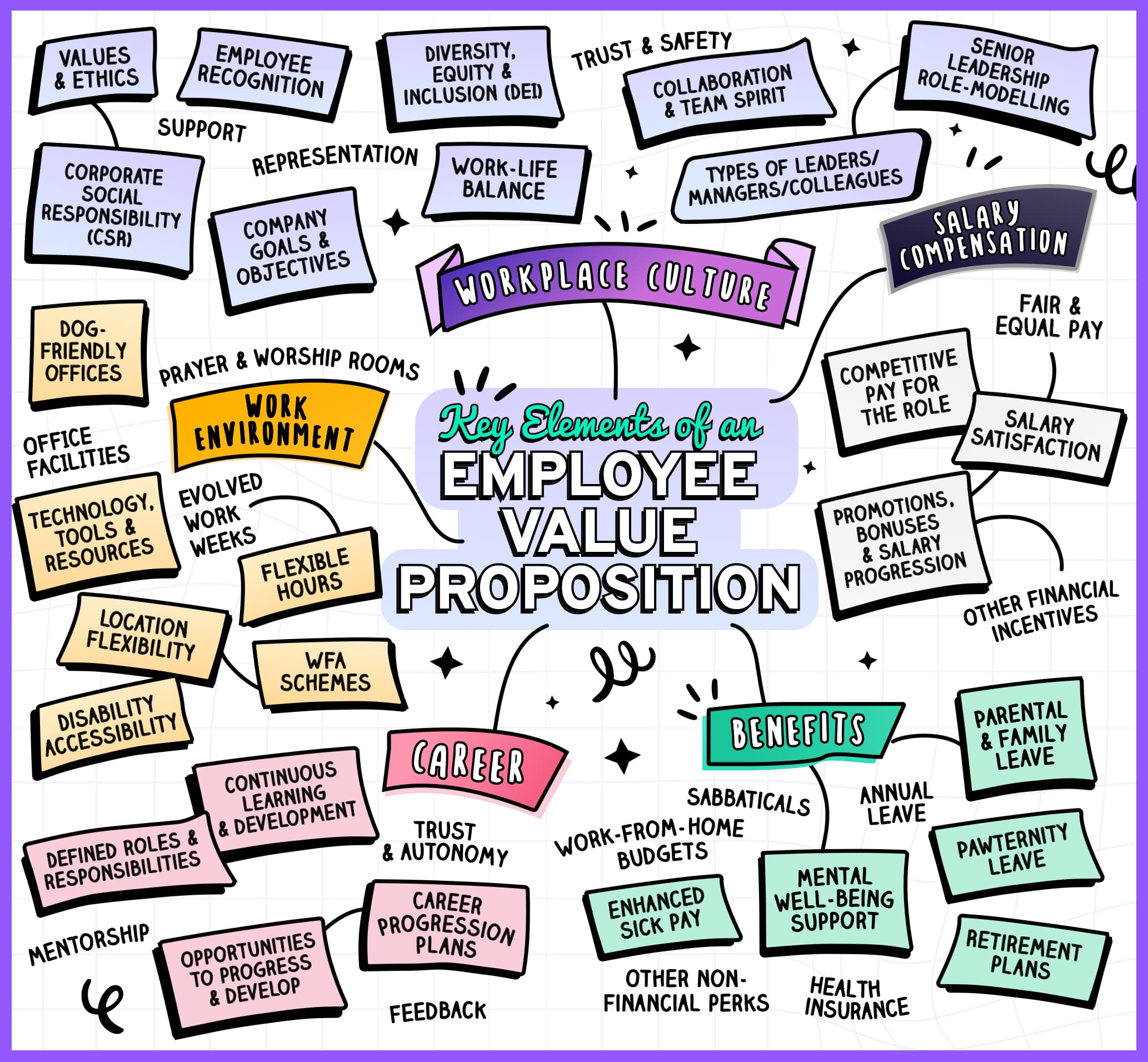
Deciding what makes a great EVP will be unique to your company. However, we believe there are some key ingredients that should feature. We will be delving into each of these elements in our Masterclass and giving you more detailed guidance on how to implement each of them.
Salary compensation
Making sure your employees are happy with their salaries is a must. We're talking about fair and competitive pay (regardless of gender, ethnicity and location); this will show that you appreciate and value their work. Bonuses, salary raises and promotions are an ideal way to showcase this; a culture where you're rewarded for your performance keeps employees engaged and motivated, as well as benefiting the company. Let's not forget about other perks too, like profit-sharing, company shares and commission structures that can really give employees a sense of ownership.
Benefits
Benefits are like the icing on the cake of your EVP; we're talking about all the other exciting stuff that doesn't involve money. Think health insurance, retirement plans, paid time off, family and parental leave, mental well-being support, sabbaticals and work from home budgets. Taking care of your people and showing commitment to work-life balance can have a hugely positive impact on overall well-being. Within this competitive market, a unique benefits package will help set you apart in attracting, retaining and engaging top talent.
Career
Growth and progression opportunities are the name of the game when it comes to attracting candidates and keeping employees engaged, whether learning new skills or tackling exciting challenges. So, what does that look like? Think about offering mentorship opportunities and training initiatives to help every employee level up. This includes clear progression plans that put employees in the driver's seat of their careers so they know exactly what they need to do to advance. A strong EVP will have an emphasis on continuous learning and development to keep employees engaged and help you retain talent.
Work environment
An EVP that incorporates inclusivity is key; and one key component of this is a work environment that's all about positivity, boosting productivity and fuelling collaboration. When we say work environment, we mean everything from location flexibility to flexible working hours, Work From Anywhere Schemes, dog-friendly offices, prayer and worship rooms and disability access. Embracing diversity and making sure everyone feels welcome and supported is a must to have a great work environment.
Workplace culture
A positive workplace culture focuses on employee engagement and satisfaction to create a sense of belonging. It represents the values and beliefs that define the overall behaviour of a company and its employees. It includes elements such as trust, open communication, teamwork, role modelling that feeds down from the leadership team, diversity and inclusion, employee recognition, work-life balance and a supportive and respectful environment.
Reward and Recognition
Acknowledging your employees' achievements is integral to your EVP. Beyond salary compensation, your team values recognition for their efforts. By celebrating the small wins as well as the big ones, you’re creating a workplace culture that motivates your employees to continue their hard work.
Values & Mission
Having a clear vision and mission helps employees understand their role in your organisation. When you embed this purpose into your EVP, it can make a difference in attracting and keeping top talent. Employees want to know how they're contributing to the company's goals as it gives them a sense of purpose and control in their work.
Investing in your EVP can make a real impact. We have seen companies like Airbus increase female engagement by 91% in just three months, Amplifi grow the diversity of their applicant pool by 65%, and TUI attract a candidate base where a third identify as neurodivergent
Having a strong EVP is what sets you apart from the competition. It acts as a powerful magnet, attracting top talent and compelling them to choose your company over others. A well-crafted EVP not only captures the attention of highly skilled candidates but also creates their long-term commitment and loyalty. It becomes the secret sauce that keeps your best employees engaged, motivated, and dedicated to your company's success. Once you have developed your EVP strategy it's important to start thinking about measures of success and employer branding funnel. You can find out more about how to get started here.
FAQs about an Employee Value Proposition
Is an EVP the same for every company?
No. While every EVP should cover similar pillars such as compensation, benefits, culture, and career development, the way those pillars are weighted and communicated should be unique to your company. Your EVP should reflect what genuinely makes your organisation a great place to work, not what sounds good on paper. A tech scale-up and a global manufacturer will have very different EVPs, even if they share some of the same elements.
Who is responsible for building an EVP?
EVP development is typically led by HR or People teams, but the best EVPs are built collaboratively. Input from leadership, marketing, and current employees all play a role in shaping something that is both authentic and strategically aligned. Increasingly, employer brand specialists are taking ownership of EVP as a dedicated function.
How long does it take to build an EVP?
There is no fixed timeline, but most companies take between three and six months to research, develop, and validate a new EVP. This includes gathering employee feedback, identifying key pillars, crafting the messaging, and verifying that what you are saying reflects the real employee experience. Rushing the process tends to produce an EVP that sounds generic rather than genuinely distinctive.
Can a small or early-stage company have an EVP?
Absolutely. In fact, smaller companies often have a stronger and more authentic EVP than larger ones because their culture is more visible and their ways of working are more distinctive. You do not need a large HR team or a big budget to define what makes your company a great place to work. Starting with honest conversations with your existing team is often the most effective first step.
How often should you update your EVP?
Your EVP should be reviewed at least once a year, and revisited whenever there is a significant change to the business such as a period of rapid growth, a change in leadership, a shift to hybrid working, or a merger. An EVP that reflected your company in 2021 may not accurately represent it today. Keeping it current ensures it continues to attract candidates who genuinely align with where you are now, not where you were.
What is the difference between an EVP and a job advert?
A job advert describes a specific role. An EVP describes why someone would want to work for your company at all. Think of the EVP as the foundation. It informs the tone, content, and messaging of every job advert, careers page, and employer brand asset you produce. Without a clear EVP, job adverts tend to focus only on requirements rather than on what the candidate gains by joining.