
September talent insights: why job sharing and part-time work are going mainstream
This month's data reveals some of the most significant transformations we've seen all year. From a surge in part-time interest to the mainstreaming of job sharing, employees across every generation are rethinking what they want from work.
7th Oct 2025
• 5 minutes
At Flexa, we track millions of data points every month to understand what candidates are really looking for in their next role. By analysing search behaviour, preference changes, and emerging trends across different demographics, we can spot the shifts that matter before they become impossible to ignore.
This month's data shows some genuinely transformative changes. Between March and August 2025, we've seen dramatic shifts across every generation and demographic, and they're reshaping how employees think about work, benefits, and flexibility.
This month’s data shows some big transformations. Here’s what’s happening:
- Part-time work is booming – interest is up 56% overall, across every generation.
- Job sharing goes mainstream – with a 70% rise among millennials and a 58% rise among men, it’s no longer niche.
- Parents are rethinking priorities – moving away from wellbeing benefits and towards structural flexibility.
- Structure beats perks – employees want predictable, flexible arrangements, not token add-ons.
The part-time revolution is here

Between March and August 2025, interest in part-time hours skyrocketed across every single generation. This is a fundamental shift in how people want to structure their working lives.
What it means: This isn't a generational quirk or a passing trend. It's universal. Employees across all age groups are questioning the "full-time as default" model that's dominated workplaces for decades. Even baby boomers, often assumed to prefer more traditional structures, are driving the highest increase at 63%. This shows that flexibility isn't a perk anymore. It's a baseline expectation for everyone.
What's next? As more candidates actively seek part-time roles, companies that only offer full-time positions risk losing appeal with a big share of the talent pool. By creating genuine part-time progression paths, you can not only attract more applicants but also retain experienced professionals who might otherwise leave the workforce.
Job sharing: the collaborative solution
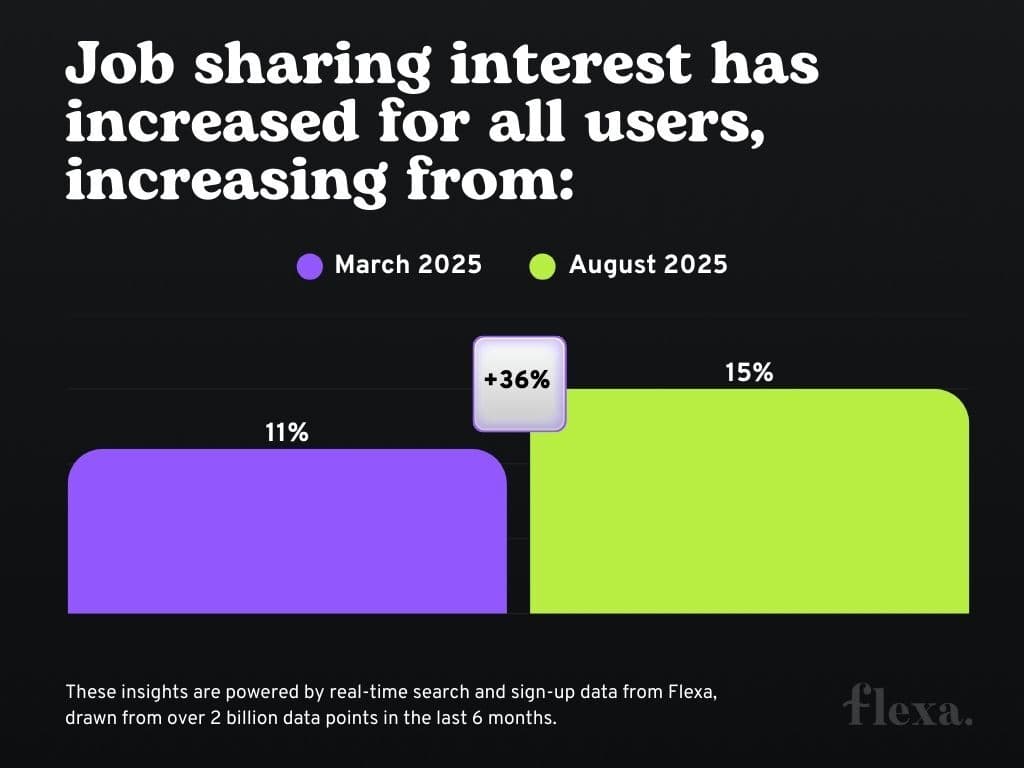
What it means: Job sharing is evolving from a niche accommodation to a mainstream choice. The substantial growth among men (58%) and millennials (70%) shows it's no longer just tied to caregiving stereotypes. Instead, it reflects a fundamental shift in how people want to work, optimising productivity, protecting wellbeing, and bringing multiple perspectives to a single role.
What's next? Employers who enable job sharing can effectively double the talent they access. Two professionals sharing one role often generate stronger outcomes than a single employee tied to rigid hours. You get fresh ideas, better coverage, higher engagement, and the combined expertise of two skilled individuals. It's a win-win that more forward-thinking companies are beginning to embrace.
Parents are prioritising structural flexibility
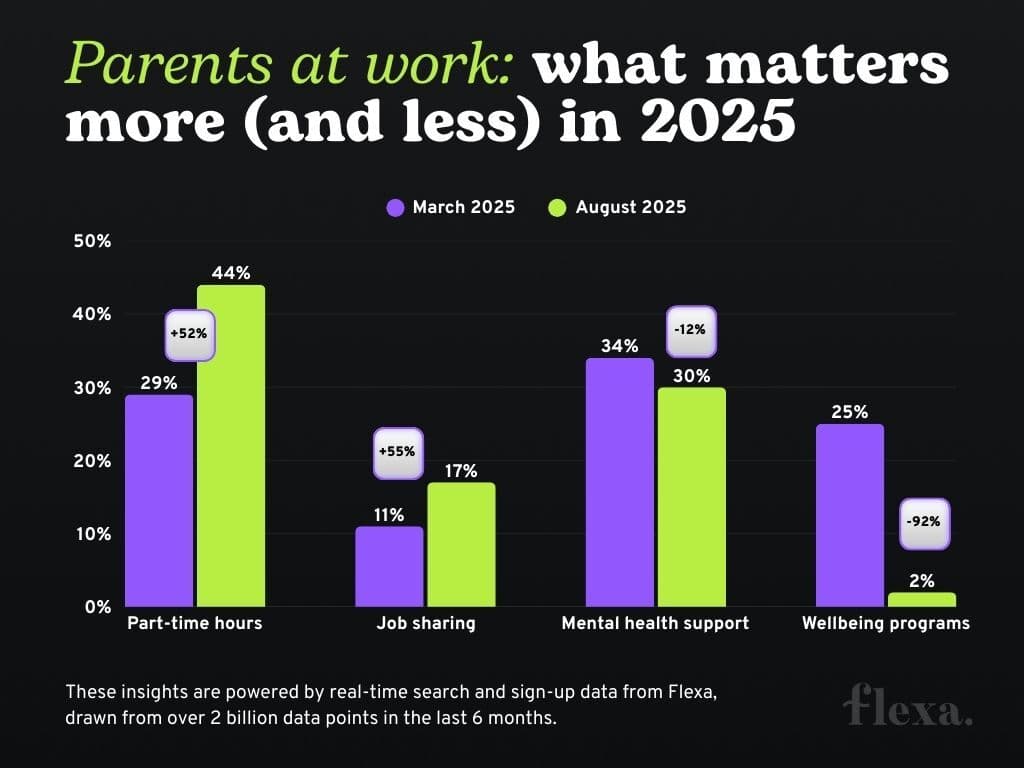
What it means: Working parents are moving away from "band-aid" solutions like wellbeing perks and gym memberships. Instead, they want fundamental changes to how work fits into their lives. The 92% drop in interest for wellbeing programmes, alongside the 52% increase in part-time demand, tells a clear story: people don't want to cope with unworkable schedules. They want schedules that actually work.
This doesn't mean parents don't value mental health support or wellbeing initiatives. It means they recognise that no amount of yoga classes or counselling sessions can compensate for a fundamentally incompatible work structure. If the hours don't work, the perks won't help.
What's next? Employers that reframe their EVP to focus on structural flexibility, not just supportive add-ons, will retain experienced, efficient parents who might otherwise scale back or exit the workforce. This is about keeping valuable talent engaged and productive, not watching them burn out or leave because the basic framework of work doesn't fit their lives.
The bigger picture: structured flexibility is what people want
What we're witnessing across all these trends is the rise of structured flexibility. Employees don't just want freedom. They want predictability plus choice. Flexible arrangements like part-time work and job sharing provide structure while still respecting individual needs.
This is different from the "work from anywhere, anytime" approach that dominated conversations a few years ago. People are realising that complete flexibility can sometimes mean constant availability, blurred boundaries, and burnout. What they actually want is clear, predictable arrangements that give them control over their time while still providing stability.
What this means for your talent strategy
These insights reveal three critical implications for employers:
1. Rethink full-time as default
The traditional 40-hour week is now a barrier to talent attraction, not a standard everyone accepts. If your roles are only available full-time, you're immediately ruling out a huge portion of skilled candidates who could add tremendous value to your organisation.
2. Job sharing is a professional choice, not just an accommodation
Stop thinking of job sharing as something you reluctantly offer to employees who "can't" work full-time. It's becoming a positive, proactive choice for professionals who want to optimise their work, bring fresh perspectives, and maintain better work-life integration. Companies that embrace this will access talent pools their competitors are missing.
3. Structure beats perks
Employees want flexibility built into how work is designed, not bolted on as an afterthought or compensatory benefit. Gym memberships and wellbeing apps are nice, but they won't make up for a rigid, inflexible work structure that doesn't fit people's lives. Focus on getting the fundamentals right first.
FAQs about part-time work and job sharing
1. What is job sharing?
Job sharing is when two (or sometimes more) people share the responsibilities of one full-time role. Each person works part-time hours but together they cover the full job, often by splitting the week or dividing tasks based on their strengths. It’s a great way to stay in a meaningful role while maintaining balance. You can learn more about how flexible working arrangements like this support better work-life balance in our recent blog here.
2. What is part-time work and how many hours is part-time?
Part-time work means working fewer hours than a standard full-time schedule. Part-time hours vary depending on the company, role, and contract. In the UK, for example, part-time typically means working fewer than 35 hours a week. Some people work three full days, while others spread shorter hours across five days. Explore our recent blog on part-time hours to see how this setup can benefit both employees and employers.
3. Why do people choose job sharing?
People choose to job share for many reasons, including achieving a better work-life balance, managing caring responsibilities, studying, or transitioning back to work after time off. It allows employees to stay engaged in their careers while keeping flexibility at the forefront.
4. How does job sharing work in practice?
Job sharing can be structured in several ways. Some people split the week, for example, one person works Monday to Wednesday and the other Wednesday to Friday. Others divide responsibilities based on expertise or project ownership. Strong communication and collaboration are key to making it work smoothly.
6. What are the benefits of job sharing and part-time work?
Both job sharing and part-time work offer greater flexibility and balance, helping people manage priorities outside of work. Job sharing also brings the benefit of two people’s perspectives, which often leads to more creativity and collaboration. For employers, these setups can improve retention, widen the talent pool, and promote inclusion. Take a look at some leading companies that are embracing these benefits.
7. Who can do a job share or part-time role?
Anyone can! Job sharing and part-time roles are increasingly popular across all industries and seniority levels. They’re a great option for parents, students, or anyone who wants to.