
AI and human skills: how to get the balance right in 2026
In this blog, we’ll share more about the importance of both AI and human skills, and how companies are managing the balance.

By Priya
Senior Content & Product Marketer at Flexa
23rd Mar 2026
• 5 minutes
Work has always evolved. New tools arrive, old ways of working fade, and expectations shift. What feels different now is the pace of that evolution. As we move through 2026, AI is no longer a future consideration. It’s already shaping how teams collaborate, make decisions, and get work done.
What’s interesting is how quickly AI has become part of everyday work, and how the need to enhance AI skills has become more important in the workplace. In a recent Flexa LinkedIn poll we asked over 700 people for their take on using AI at work. We found that 44% of respondents said they now use AI frequently but at the same time, 39% said they do not feel supported by their company in using it.
That gap matters. Because thriving in this new world is not about becoming an AI expert overnight. It’s about understanding where technology helps, where humans excel, and how the two work best together.
Why human skills will always be important
For a long time, skills were treated as separate lanes. You were either technical or people-focused. Analytical or creative. Strategic or empathetic.
That divide does not hold up anymore.
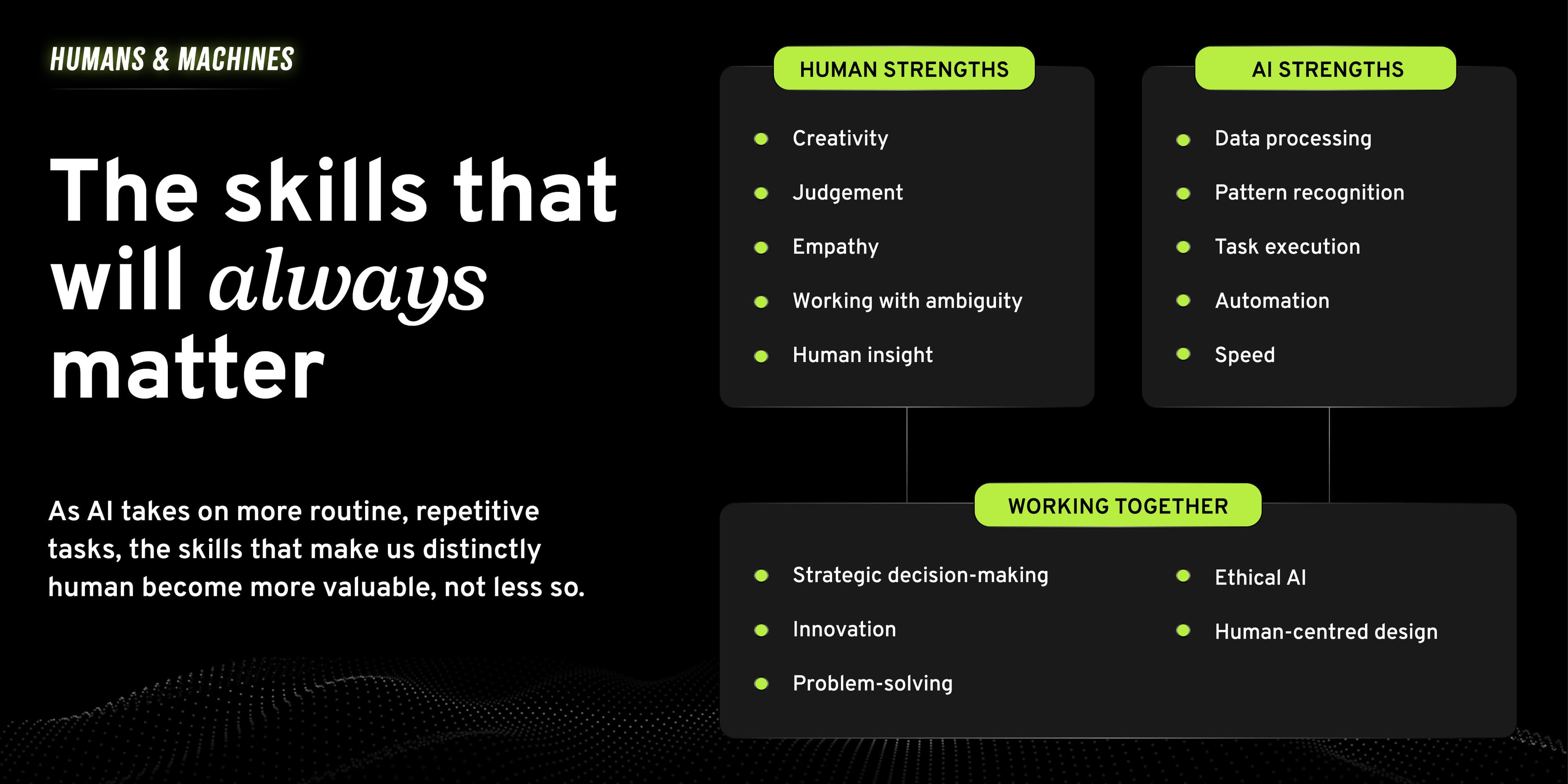
For example, technical capability without human judgement can lead to poor decisions. Human skills without an understanding of modern tools can slow teams down. The people who thrive are those who can blend both, moving comfortably between data and instinct, automation and insight.
Adaptability sits at the heart of this shift. Roles are changing faster than job titles can keep up, and learning is no longer something you do between jobs – it’s part of the job. The most valuable skillset in 2026 is not a fixed list. It’s the ability to keep learning, adjusting, and staying curious as work evolves.
AI is already part of most jobs – so how do we embrace it?
Nearly half of professionals are using AI regularly at work, whether that is to draft content, analyse data, streamline admin, or support planning.
The challenge is not adoption. It’s support.
When people are left to figure AI out on their own, it can feel overwhelming or risky. Without clear guidance, training, or cultural permission, even the most useful tools can create friction rather than flow.
Used well, AI removes friction from work. It takes care of repetitive tasks that drain time and energy. It surfaces insights faster. It supports better decision-making by giving people stronger foundations to work from.
What it cannot do is replace human context, emotional intelligence, or ethical judgement. Embracing AI is not about handing work over to machines. It is about giving people better tools so they can focus on the work that needs a human touch.
How to get the perfect balance of humans and machines
Internal mobility refers to employees moving between roles within the same organisation. This can mean lateral moves to different departments, upward promotions, temporary assignments, or even downward shifts that align better with personal goals or work-life balance.
But it's more than just moving people around. At its core, internal mobility is about creating an ecosystem where talent can flow to where it's needed most, where people can grow in multiple directions rather than just up, and where organisations can adapt quickly to changing demands without constantly recruiting externally.
Think of it this way: traditional career paths are like ladders - you go up or you go nowhere. Internal mobility creates a jungle gym instead. You can move sideways to build new skills, climb diagonally to combine expertise areas, or even move down temporarily to pivot into a completely new direction. The destination isn't predetermined; the journey itself becomes the opportunity.
Why does this matter now more than ever? Because the half-life of skills is shrinking rapidly. The skills you hired someone for three years ago might be partially obsolete today. Rather than constantly replacing people, smart organisations are redeploying and reskilling the talent they already have. Which means keeping people who understand the culture, know the systems, and have proven themselves reliable.
Companies embracing AI in the workplace
Some organisations are already showing what thoughtful, people-first AI adoption looks like. Here, some of our Flexa-verified companies explain more about how they are adopting AI in the workplace and the approach they are taking.
For years, conversations about AI at work have been dominated by one question: will I be replaced?
At Hurree, we've learned that's the wrong question entirely.
The real shift isn't about humans versus machines – it's about how people grow when technology is designed to support them, not sideline them. As AI becomes part of everyday work, the skills that matter most are changing.
But they're not what many people expect.
There's a misconception that thriving in an AI workplace means learning to code
or becoming a prompt expert overnight. Those skills can help, but they're not the
foundation.
The people who adapt best tend to share a different set of traits:
- Curiosity over certainty: AI evolves quickly. The people who thrive ask better questions rather than claiming to have all the answers. They test, learn, and adapt – not because they have to, but because they're genuinely interested.
- Critical thinking: AI can surface insights in seconds, but it can't judge context, ethics, or nuance. Someone still needs to ask: "Does this make sense? Is this the right move? What are we missing?" That's always human work.
- Comfort with change: Roles are becoming more fluid. The specifics of "what you do" might shift every six months. People who see that as interesting rather than threatening have a massive advantage.
- Clear communication: When AI removes busywork, what's left is collaboration, alignment, and clarity. The ability to explain your thinking, listen well, and work across teams becomes more valuable, not less. These are human skills. And they're becoming more valuable, not less.
There are still questions we're wrestling with. How do you upskill a team when AI changes every quarter? How do you balance automation with the need for people to feel ownership over their work? What happens when AI makes someone's role obsolete, even if that wasn't the intention? These aren't easy questions, and anyone claiming they have perfect answers is lying. What we do know is this: the workplaces that will thrive are the ones willing to experiment, fail, learn, and adjust – just like the people in them.
“For me, AI is an elevation tool, not a replacement strategy. At Boomi, we leverage AI to remove administrative friction and surface deeper insights, which creates space for our team to enhance the candidate experience, build stronger relationships, and serve as strategic advisors to the business.
Automation drives efficiency, but judgment is not a commodity. The discretion and accountability required to hire exceptional talent and strengthen culture remain firmly human. That's why we leverage technology to streamline and refine our processes, so that we can double down on what truly defines great hiring: empathy, discernment, and ethical decision-making.
Amanda Yates, Global Head of Talent Acquisition, Boomi
We’re delivering the biggest upgrade to our water and water recycling systems in a generation. New reservoirs, upgraded sewers, smarter networks – it’s happening at pace. And to make it all work, we need people who want to explore, learn and help shape a better future for our region. Because behind every new pipe we lay and every river we protect, there’s a team of curious, committed people driving it forward.
AI, data and smart technology are becoming everyday tools for us. They’re helping us spot issues earlier, plan better and make quicker decisions. We’re embracing them fully, but always alongside the judgement, creativity and responsibility only people bring. And we're already putting them to work.
As we deliver the biggest investment in our water and water recycling systems we have ever seen, one thing remains constant: it’s our people who make the difference. Technology will help us move faster and have a greater impact, but it needs to be coupled with the curiosity, care and commitment of our teams. By growing the skills we need today, we will shape a better future for our region. We’re building the capability to deliver for decades to come, creating lasting value for our communities, our environment and the customers who rely on us every day.
‘AI or die’ wasn’t a slogan — it was the title of an internal memo from Circle’s CEO, Sid Yadav. Sid wrote a Notion memo with this exact title and included the preface that: the world is rapidly undergoing an AI transformation, and Circle will need to be part of this in order to survive and thrive.
This philosophy and the strategy that Sid lays out in the memo speak not only to several of our values – Product First, Grow Together, Long-Term Thinking – but also to the way we value the people that make Circle what it is, both as a team and as a broader community of Circle users, creators, and connectors.
As Sid put it, the goal of using AI at Circle is to increase quality while decreasing human effort; not to replace humanness altogether.
Circle has given its employees a clear directive on the expected use of AI in all of our roles and functions. We’ve given people room to explore and try new AI tools, while also providing resources for employees to purchase these tools, attend a class or a course, and approach AI with intention and clarity. We’ve begun 2026 making active strides from testing to implementation and have already been experiencing meaningful gains in how we work.
You can read more about Circle’s approach to AI in our latest Talent Insights Report here.
Leon Strauch, Senior Manager in Enterprise Agentic Automation shares more on how Camunda is embracing AI.
At Camunda, we see Agentic AI as a way to scale impact by amplifying every individual in our organization. And we are building it on our own Camunda platform.
Our ambition is clear: automate the repetitive, orchestrate intelligent processes, and elevate human contribution. Wherever work is manual, repetitive, or time-consuming, we look for opportunities to redesign and orchestrate processes in Camunda, embedding AI where it creates real impact. The goal is not efficiency for its own sake. It is about freeing Camundi to focus on what truly creates value: making sound decisions, solving nuanced problems, collaborating across teams, and building strong customer relationships.
A concrete example is our work within Customer Support. Supporting a powerful and composable product like Camunda means navigating complexity every single day. To help our engineers stay at the top of their game, we are building Ticket Genie, an Agentic AI support companion orchestrated on the Camunda platform. It brings together context from multiple data sources, provides structured analysis, and suggests reply templates to accelerate response times, while supporting employee onboarding.
Looking ahead, we aim to orchestrate more cases through AI-driven self-service. Routine issues can be resolved instantly, while engineers focus on high-impact challenges that require deep expertise and collaboration. Faster answers for customers. More meaningful work for employees.
Most importantly, the way we scale AI at Camunda is designed to be inclusive. We have open communication channels for ideas and are providing the tools and platform access for teams and individuals to experiment and build. Scaling Agentic AI is not a finished state. It is a company-wide capability we are actively developing. By using our own technology to redesign how we work, we strengthen our internal efficiency while enabling our people to focus on what they do best.