
The top benefits employees want in 2026
In this article we explore the most in-demand benefits shaping workplaces this year, from WFA schemes and flexible working to health and wellbeing support.
2nd Feb 2026
• 5 minutes
The world of work is being reshaped as we speak, and for many employers, attracting and retaining talent has never felt more complex.
Rising living costs are reshaping where people can afford to live. Caring responsibilities are pulling more people out of full-time work. Poor mental health is forcing many to rethink what “success” at work even looks like. And at the same time, the job market is tightening. Between August and October 2025, unemployment rose to its highest level since 2015, with the unemployment rate reaching its highest point since 2021.
On the surface, this looks like a market where candidates might feel they should simply take what they can get. But the reality is very different.
Even in a tougher, more employer-led market, people are not just looking for any job they can find. They are looking for work that fits into their lives, supports their wellbeing, and gives them room to grow.
That is why benefits matter more than ever. Not as flashy perks, but as practical tools that make work possible.
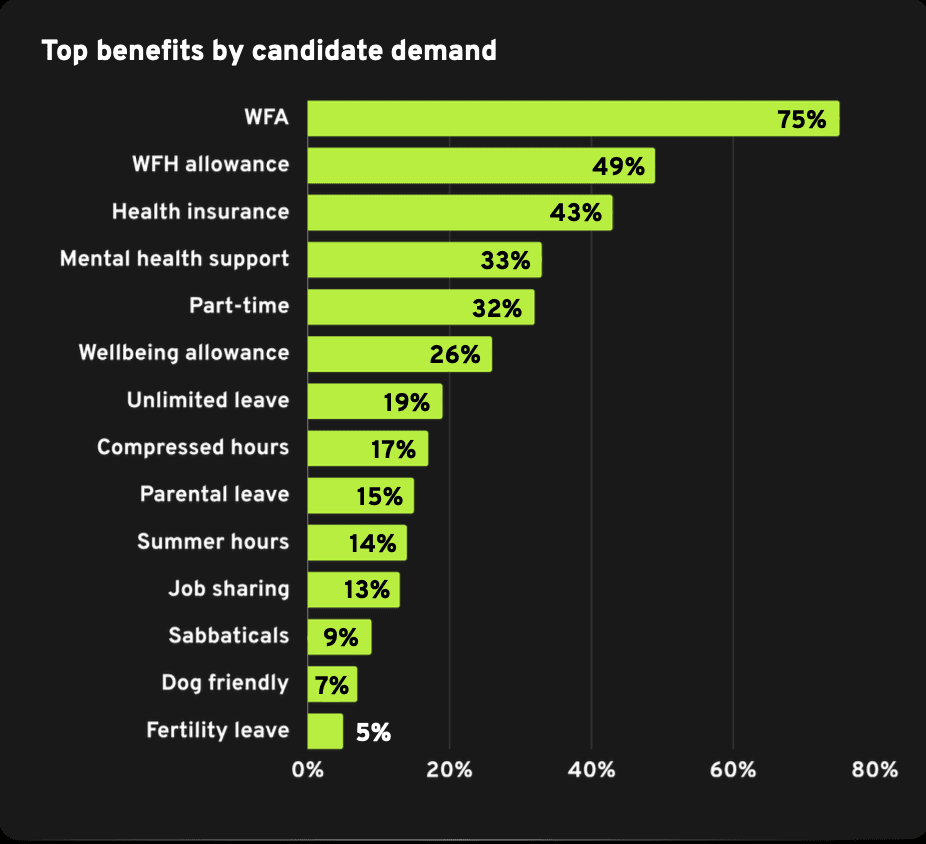
Flexa’s data shows a clear pattern. Candidates are prioritising flexibility, wellbeing and work design in ways we have not seen before. And for HR leaders, this is not theoretical. These priorities are shaping who applies, who accepts offers, and who stays at companies in 2026.
1. WFA schemes remain at the top
Work from anywhere (WFA) schemes have continued to hold the top spot when it comes to benefits over the past year, with three-quarters of candidates prioritising this as part of their desired benefits package.
This aligns with wider workforce trends and a growing appetite to live and work abroad. According to the Office for National Statistics, 195,000 people under the age of 35 moved overseas in the year to June 2025. With the rising cost of living, more people are actively considering whether their lives and their work might be better elsewhere.
WFA schemes give employees the freedom to test that possibility. They allow people to explore living in other countries without having to choose between career and lifestyle.
While demand has grown most sharply among Gen Z, we have also seen a steady increase among millennials and parents throughout the year. That tells us this is not a niche benefit for one generation. It is becoming relevant across life stages.
WFA schemes are not about novelty anymore. They are about choice, freedom, and building a life that works.
Why this matters for HR leaders
Candidates want autonomy over where they work and practical support to do it well. This reflects a broader shift. Work life balance and flexibility are now top priorities across generations.
For HR leaders, WFA is not just a differentiator. It is quickly becoming part of what people expect from a modern employer.
2. Health and wellbeing benefits are no longer optional
Employees are increasingly prioritising benefits that support their mental health and wellbeing, not just their pay packets.
Almost 15% of working-age adults now report having a long-term mental health condition, and one in five workers has needed time off because of stress-related mental health concerns. Health in the workplace can no longer be ignored.
But this goes beyond the benefits offered alone. It is about how wellbeing is embedded holistically into a company’s EVP. Many organisations offer mental health platforms or access to therapy, but those making a real difference are building wellbeing into their culture from the start.
That means visible leadership role modelling, manager training, open conversations, and listening to employee feedback, not just adding another benefit to a list.
Why this matters for HR leaders
Benefits packages that support both physical and mental wellbeing, and address the causes of poor health rather than just the symptoms, will stand out. Candidates are increasingly judging whether an employer truly values wellbeing enough to invest in it, not just promote it.
3. The 9–5 no longer works: why flexibility matters in 2026
While not as highly ranked as WFA or health coverage, benefits like part-time work, compressed hours and job sharing reveal another important layer of candidate priorities: flexibility in how work is structured.
These working patterns appeal to people whose lives do not fit a traditional 9–5 mould. That might be because of caregiving responsibilities, health needs, or simply a desire for better balance between work and life.
Research from Carers UK shows just how big this issue is. Around 2.6 million people have given up work to care, which is roughly 600 people every day. Those providing unpaid care are also far more likely to be working part-time than those without caring responsibilities.
This means that when roles are designed only around a rigid 9–5, entire groups are quietly excluded from the workforce. For many people, flexible working patterns are not about having more choice. They are the only way work is possible at all.
Why this matters for HR leaders
This is a call to rethink rigid work designs. Providing multiple work-pattern options (not just where people work, but how they work) expands your talent pool and appeals to a broader range of candidates.
What this means for HR leaders in 2026
In a candidate-driven market, benefits are no longer optional add-ons. They’re strategic assets to your EVP. Here’s how you can approach your benefits package in 2026:
1. Build benefits packages around real needs
Candidates are telling us they want:
- Practical flexibility (work from anywhere, WFH support)
- Health and wellbeing support (physical & mental)
- Meaningful schedule flexibility (part-time, compressed hours)
2. Identify your gaps
Are the benefits you’re currently offering aligned with what your target talent wants? This is a good place to start when thinking about your benefits in 2026. Our Persona Dashboard is a great way to get started when understanding which benefits matter to different personas. You can take a look at an example persona here.
3. Communicate your benefits clearly
Candidates won’t read between the lines. Benefits matter only if they’re visible and easy to understand in your employer brand content. Flexa verified employers shout about all their benefits on their profiles making it easier for candidates to discover them.