

Future of Work Insights: the must-have family-friendly benefits for 2025
This blog features data and insights into how to support working parents, what they want from employers, and practical steps to create a truly family-friendly workplace.
9th Apr 2025
• 5 minutes
This blog will cover:
- The most in-demand family-friendly benefits for 2025
- How benefit preferences differ between mothers and fathers
- Why senior women leaders value family support more than ever
- Shifting work location preferences among working parents
- What HR and talent professionals should prioritise to attract parent talent
The modern workforce is increasingly prioritising work arrangements that support family life, with clear preferences emerging for specific benefits. Our latest data at Flexa reveals which family-friendly benefits are most in demand, how these preferences differ between mothers and fathers, and what this means for organisations looking to attract and retain top talent.
Family-friendly benefits: what parents want most

When it comes to family-friendly workplace benefits, part-time arrangements (28.4%) and unlimited leave (24.4%) emerge as the clear favourites across the workforce. This highlights how strongly employees value having control over their time, allowing them to balance work responsibilities with family needs.
Compressed hours and parental leave follow closely behind with nearly identical demand levels (16.7% and 16.5% respectively), showing that alternative scheduling options and dedicated family support remain key considerations for a significant portion of working parents.
While job sharing (8.7%), dog-friendly workplaces (8.6%), and fertility leave (5.6%) show lower overall demand, they represent important benefits for specific segments of employees. This shows the importance of offering diverse benefits packages that can address different needs at various life stages.
Mothers vs. Fathers: understanding the gender gap in benefit preferences
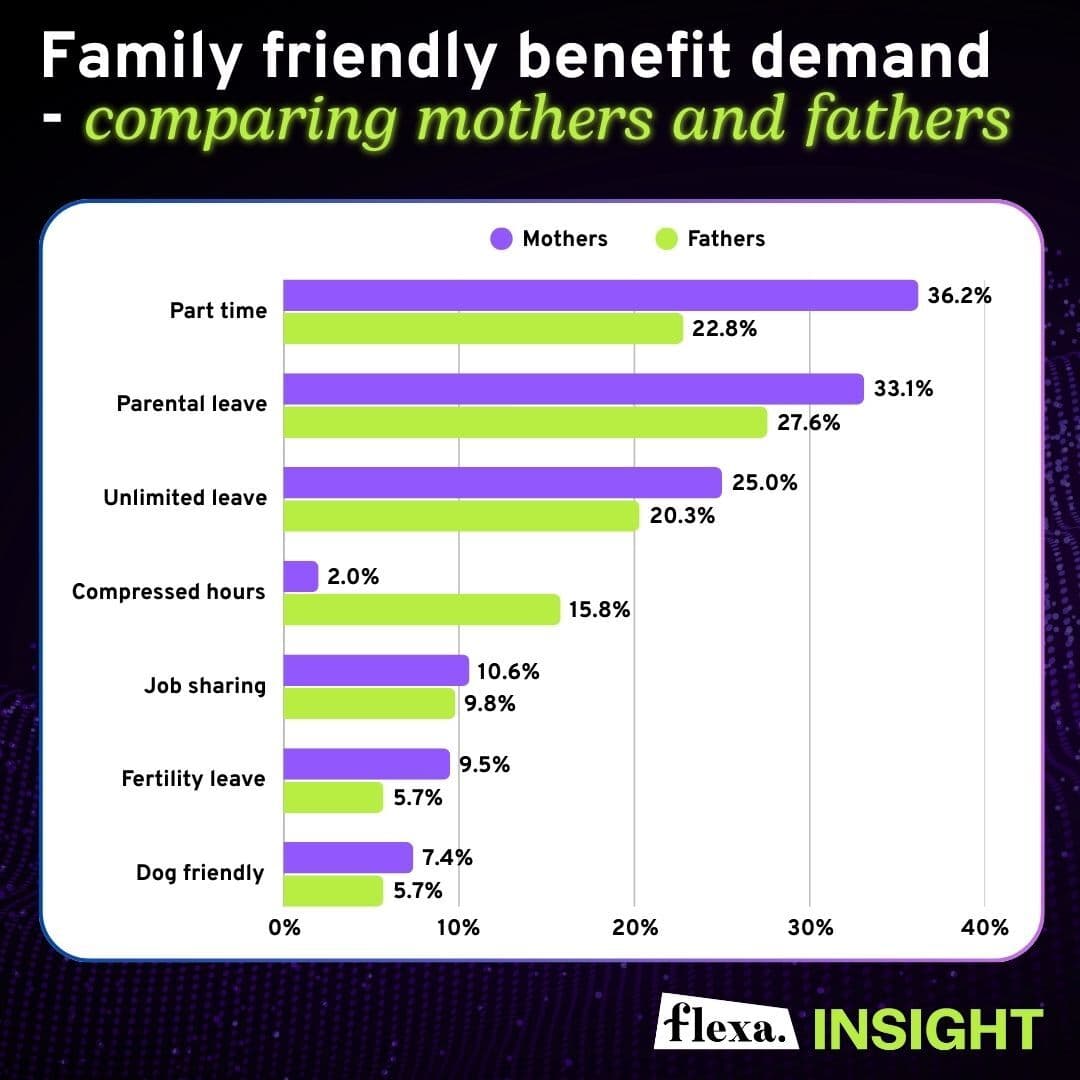
Our data reveals important differences in how mothers and fathers prioritise workplace benefits. Across all categories, mothers consistently show higher demand for family-friendly benefits, though fathers also express significant interest.
Part-time arrangements are most sought after by mothers (36.24% vs. 22.80% for fathers), while parental leave shows strong demand from both groups and is the most desired benefit for fathers (33.14% for mothers vs. 27.55% for fathers). This indicates a shared desire for time-based flexibility, though the higher percentages among mothers reflect the ongoing reality that women often shoulder more caregiving responsibilities. A recent survey revealed that 25% of mothers are being forced to quit work to accommodate childcare, compared to only 7% of fathers. This contrast further highlights the discrepancies that still exist when it comes to childcare responsibilities and flexible working. To make the workplace more inclusive for all parents, flexible working needs to become the norm for everyone.
The relatively high demand among fathers for benefits like parental leave demonstrates that men are increasingly seeking active roles in family life. Progressive employers should note that family-friendly benefits are valued across genders, with compressed hours, unlimited leave, and job sharing all showing interest from both mothers and fathers.
Senior women leaders value family support even more
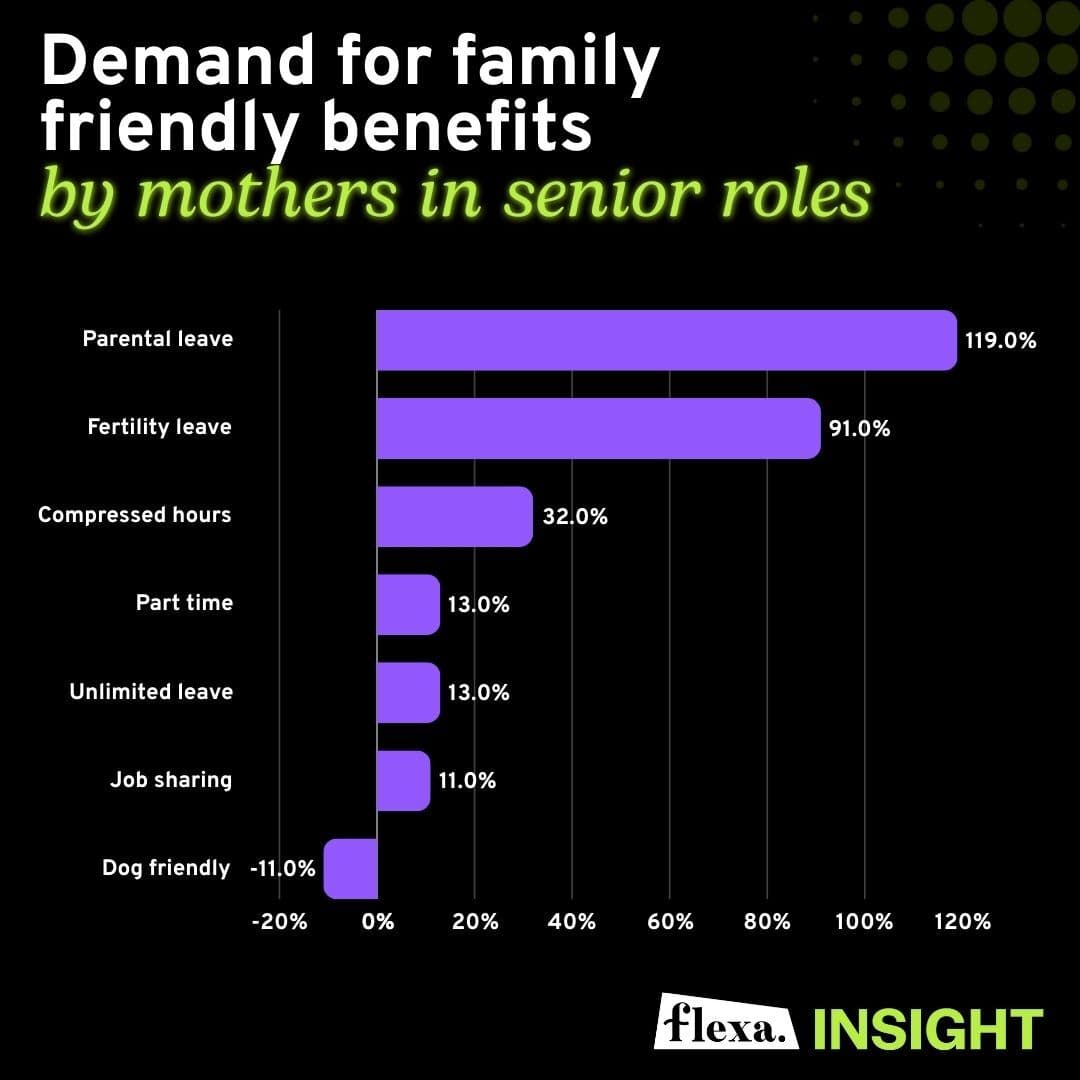
Perhaps most striking is what our data reveals about mothers in senior leadership positions. These women show dramatically higher demand for parental leave (+119% above average) and fertility leave (+91% above average) compared to the general population.
This suggests that as women reach leadership roles, they're looking for companies that support them through critical life stages and family planning. The substantial demand for compressed hours (+32%) indicates that even senior-level mothers value flexibility in when and how they work, allowing them to excel professionally while managing family obligations.
Interestingly, while part-time arrangements and unlimited leave show more modest increases (+13% each), they remain important.
How working parents want to work in 2025
Our data reveals a clear shift in work location preferences among working parents—and it’s all about genuine flexibility.
- Fully remote roles are more popular than ever, now preferred by 63% of working parents. This marks a sharp rise from the start of 2024, reflecting a growing need for work that fits around family life.
- Remote-first roles (where there's a central office, but remote work is the norm) have become less appealing—now chosen by 25% of working parents.
- Hybrid roles have continued to decline in preference, currently sitting at just 10%.
- Office-based roles remain the least desirable, with only 2% of working parents opting for them.
These shifts highlight a strong demand for working environments that offer true autonomy over where and how work happens. For working parents, fully remote roles mean less time commuting, more time with family, and the ability to better manage both personal and professional responsibilities.
It’s a reminder that flexibility isn’t just a nice-to-have—it’s becoming a non-negotiable for working parents.
What this means for HR and talent professionals
These insights point to several key strategies for building an attractive employer brand in 2025:
- Offer a diverse range of family-friendly benefits - Part-time options and unlimited leave are most valued, but compressed hours and parental leave also show strong demand.
- Design family benefits for everyone - Recognise that while mothers show higher demand for family-friendly benefits, fathers are also seeking these supports in significant numbers.
- Support women in leadership - Understand that mothers in senior roles have specific needs around parental leave and fertility support, and that addressing these can help retain top female talent.
- Prioritise flexible remote work options - With increasing demand for remote arrangements, offering flexibility in where work happens remains crucial for attracting parent talent.
Where does our data come from?
At Flexa, our insights are powered by real-time search and sign-up data from thousands of professionals. By analysing over 100 million data points on what candidates want, company EVPs, and employee satisfaction, we help employers move beyond outdated hiring tactics. Instead of relying on generic messaging, companies can align their employer brand with the evolving expectations of today’s talent—ensuring they attract the right people, in the right way.
Want to learn more about how your company can adapt to these changing workplace expectations? Find out more about our platform.
FAQs about family-friendly benefits and supporting working parents
1. What are the most popular family-friendly benefits for 2025?
According to Flexa’s data, the most in-demand benefits are part-time arrangements (28.4%) and unlimited leave (24.4%). Compressed hours (16.7%) and parental leave (16.5%) are also high priorities, showing employees’ growing desire for control over their time.
2. How do benefit preferences differ between mothers and fathers?
Mothers consistently show higher demand across all family-friendly benefits, especially for part-time work (36.24% vs. 22.80% for fathers). However, fathers show strong interest in parental leave (27.55%), reflecting a growing desire to share caregiving responsibilities.
3. Why do senior women leaders value family benefits so highly?
Data shows mothers in senior roles value parental leave (+119% above average) and fertility leave (+91%) far more than average. These benefits support women through critical life stages and help retain top female talent in leadership.
4. What work setups do working parents prefer in 2025?
Fully remote roles are now preferred by 63% of working parents, up significantly from early 2024. Remote-first and hybrid setups are declining, while office-based roles are least desirable (just 2%). Parents clearly want work that offers autonomy and balance.
5. How can companies create a truly family-friendly culture?
Offer a mix of flexible and inclusive benefits, including part-time options, unlimited leave, and equal parental leave for all parents. Encourage remote work and normalise flexibility for everyone—not just parents—to build a more equitable workplace.
6. Why should HR teams care about family-friendly benefits?
Family-friendly policies aren’t just a perk—they’re a core part of employer branding and talent attraction. Companies that design inclusive benefits for every stage of life build loyalty, improve retention, and stand out to top talent.
7. How can data help companies shape their family-friendly policies?
Platforms like FlexaInsight use real-time data from thousands of professionals to identify what employees truly want. This helps HR teams move beyond assumptions and design benefit packages that align with actual workforce expectations.