

Workations done right: balancing flexibility and risk management with WorkFlex
In this blog, WorkFlex shares key insights to help your business navigate the complexities of work-from-anywhere benefits, ensuring your company remains protected while continuing to offer the flexibility your employees value.
23rd Jan 2025
• 5 minutes
The workplace is evolving, and with it comes an exciting trend: workations. By definition, workations allow employees to work from locations away from their regular workplace. Some call it "temporary work from abroad" or "mobile work abroad," but the concept remains the same – offering employees the freedom to work from anywhere.
Imagine your software developer coding from a café in Barcelona, or your marketing manager extending their family visit abroad while staying connected with their team. According to WorkFlex research (2024), in most companies this isn't just a dream – nearly 60% of organisations now offer work-from-anywhere schemes, making it the new norm rather than a luxury perk.
Why offering workations makes business sense
The widespread adoption of workations isn't surprising. HR teams frequently report that flexible location policies significantly influence candidates' decisions to apply. The numbers reported by companies offering this perk tell a compelling story about the benefits to existing employees as well (TUI Workation Index, 2024):
- 76% boost in employee satisfaction
- 74% boost in employee retention
- 69% boost in employee motivation
- 66% improvement in work-life balance
- 54% improvement in company culture
How companies structure their workation policies
Companies are implementing workations in various ways. Based on WorkFlex data, workation policy settings differ significantly by company type (fully remote vs. hybrid) and industry.
Companies with a fully remote workforce typically set their work-from-anywhere allowance high—above 100 days abroad yearly. In contrast, companies with on-site and hybrid workers often offer fewer remote days to ensure fairness across their workforce. However, many organisations balance this by providing alternative flexibility benefits to non-remote workers, such as adjustable working hours, customisable benefit packages, and sabbatical opportunities.
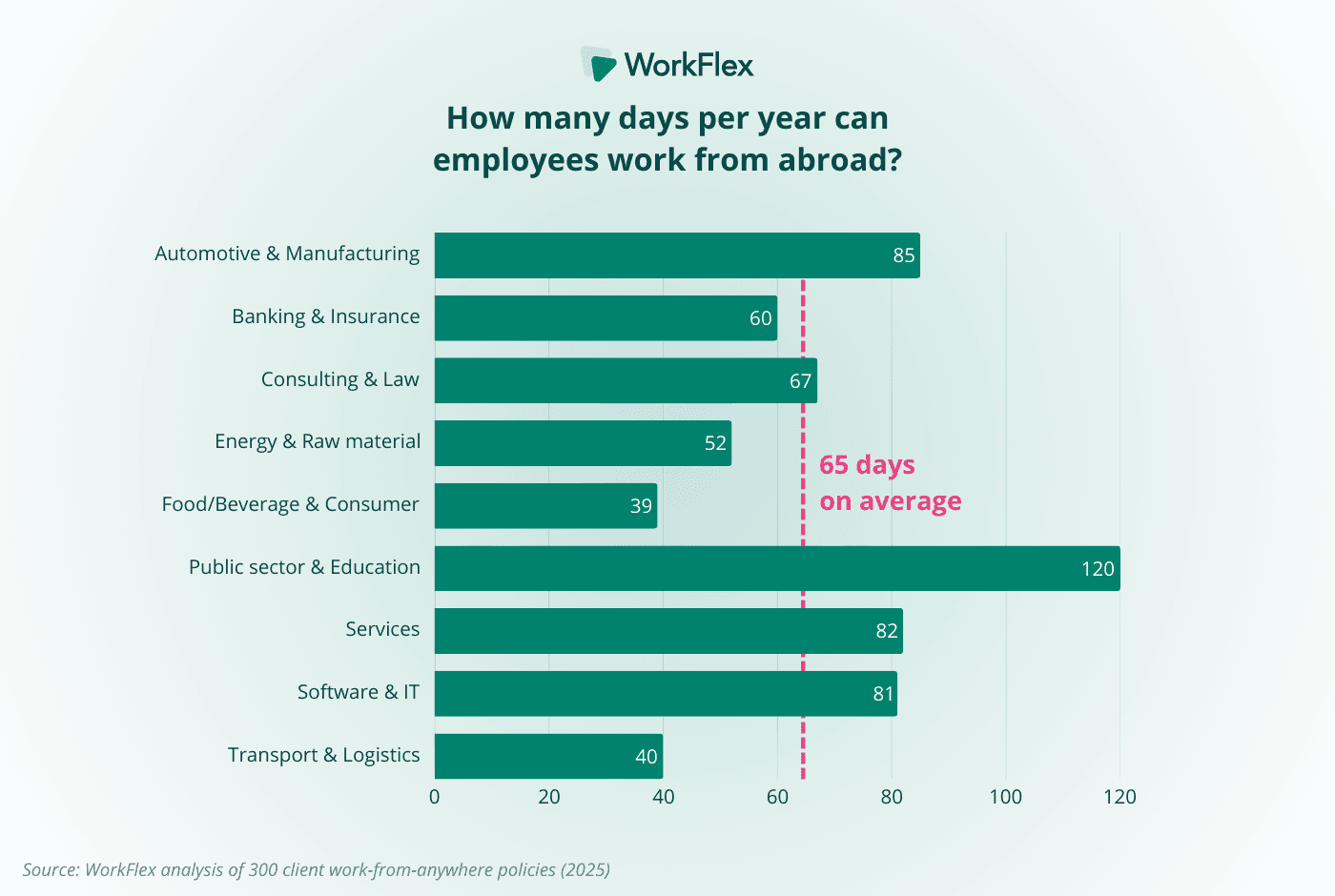
Source: Workation allowance by industry, WorkFlex research (2025)
The hidden challenges: understanding workation risks
While employers are eager to offer workations as an attractive benefit, a WorkFlex survey (2024) exposes a troubling pattern: companies aren't recognising the compliance risks associated with this perk. Most organisations aren't taking compliance measures seriously enough:
- Only 51% introduce employees to their workation policy
- Just 43% have implemented a formal approval process
- Merely 42% provide essential travel health insurance guidance
- A mere 40% assess compliance risks before trips
Without proper compliance management, what starts as an attractive benefit can quickly turn into a significant liability. Both employers and employees may face substantial fines and administrative burdens—exactly the opposite of what companies hope to achieve when offering this perk.
The eight critical risk dimensions of workations
Let's examine the eight critical risk dimensions that need to be managed for a successful workation program:
Immigration and work authorization
- Challenge: Workations often may not neatly fit into traditional visa categories
- Impact if unmanaged: Penalties of €5,000+ and potential country entry bans
Corporate income tax
- Challenge: Risk of creating a permanent establishment
- Impact if unmanaged: 20-35% tax rates over attributable profit, and €50,000+ in administrative obligations
Employment tax
- Challenge: Foreign payroll obligations
- Impact if unmanaged: Employment tax up to 60% of remuneration, potentially even 150% if grossed up
Social security
- Challenge: Dual risk of losing home coverage and triggering foreign obligations
- Impact if unmanaged: €5,000-15,000 in annual contributions per employee, €5,000+ in administrative obligations
Labor law
- Challenge: Applicability of local employment regulations
- Impact if unmanaged: Unexpected obligations regarding local working conditions like wages, hours, and benefits
Posted Worker compliance
- Challenge: Special EU requirements for cross-border work
- Impact if unmanaged: Penalties of not registering timely plus reputational damage
Health & safety
- Challenge: Duty of care obligations abroad
- Impact if unmanaged: Medical expenses, evacuation costs, legal liability
Data protection
- Challenge: Cross-border data transfer and security
- Impact if unmanaged: Penalties exceeding €5,000 plus reputational damage
The solution: making workations work with WorkFlex
These compliance risks, while significant, shouldn't stop you from offering workations to your employees. That's where WorkFlex comes in with our all-in-one global mobility compliance management software and the groundbreaking no-risk workations concept.
Here's how we make workations work:
Each employee workation request requires an individual approach since compliance risks are impacted by employee-specific factors: home country regulations, destination country regulations, employee demographics, trip details, as well as company policy.
To ease the workload of HR and global mobility specialists, as well as to ensure 100% compliance for every employee trip, WorkFlex software provides automated compliance risk assessments based on employee- and trip-specific details.
After a workation request has been submitted by an employee, WorkFlex global compliance engine starts a 3-step process.
Step 1: Identify and assess compliance risks
Considering the trip details and employee demographics, the WorkFlex compliance engine evaluates compliance risks across eight main dimensions:
- Immigration and work authorization
- Corporate income tax
- Employment tax
- Social security
- Labour law
- Posted worker directive
- Health and safety
- Data protection
Within a few minutes, you will receive a thorough compliance risk assessment specific to the trip, accompanied by a final mark using the traffic light system: green or yellow for a no-risk workation, and red for high risk.
Step 2: Implement risk mitigation measures
Once the compliance risks are identified, WorkFlex automatically implements all relevant measures to mitigate these risks:
- Employee instructions: A document that supports the employee with their trip from A to Z, summarizing considerations for entering the destination country, working in the destination country, traveling safely, insurance, internet and data security, and other details.
- A1- or CoC-Certificate: Specifies the applicable social security scheme for the traveler, helping to mitigate social security risks.
- Travel health insurance certificate: Provides worldwide coverage, insuring the employee against health and occupational risks.
- GDPR Transfer Impact Assessment (TIA): A systematic evaluation conducted to assess the potential impact of transferring data from one location or jurisdiction to another. It involves a comprehensive analysis of the data protection and privacy implications associated with the transfer, ensuring compliance with relevant data protection laws and regulations.
- Audit trail: WorkFlex automatically captures and stores all travel details, from initial trip requests to manager and HR approvals, complete with timestamps. This ensures transparency and accountability throughout the process, with all necessary information accessible in one place.
Step 3: If any risks arise during the trip, WorkFlex takes full liability
If any risks materialize during the employee's trip, which is highly unlikely given all the compliance risk assessments and documents provided, WorkFlex takes full liability, ensuring a no-risk experience for both the employer and the employee. WorkFlex supports with the following:
- 24/7 availability for consultations: Employees are provided with a telephone number and email address for the WorkFlex team, which can be reached at any time if compliance issues arise during the trip.
- Assumption of liability: WorkFlex assumes liability up to an amount of €50,000 in the event of legal disputes. Additionally, we support our clients in discussions with the authorities of a country when they reach out. The financial aspect covers local corporate tax, social security premiums, or employment tax
What does this mean for your organisation?
With WorkFlex, you can:
- Eliminate compliance risks across all major risk dimensions
- Reduce administrative costs by avoiding the need for expensive legal consultations
- Save time through automated processes
- Offer workations confidently and safely
Best of all, you can expand your workation program globally. Currently, 85% of companies using WorkFlex allow workation requests worldwide (excluding only security-restricted countries), knowing they have robust protection in place.
Ready to get started?
Don't let compliance concerns hold you back from offering the flexibility your employees want. Join leading employers like BioNTech, Pantheon, and Scout24 in providing safe and compliant workations that benefit both your employees and your business.
The first step is creating a well-structured workation policy. WorkFlex has developed a free template for you, available here.
To learn more about our no-risk workations solution, visit WorkFlex or schedule a meeting with our team to discover how we can help you implement a successful work-from-anywhere program that keeps both your company and employees protected.
With WorkFlex, you're just one step away from offering the work-from-anywhere benefit your employees dream of – without the compliance headache.