

From compliance to culture: how to build accessibility-first workplaces
In this Q&A, Toby Mildon, Diversity and Inclusion Architect and author of "Building Inclusivity", shares his thoughts and advice on how to design workplaces where everyone can thrive.
29th Oct 2025
• 5 minutes
What is disability inclusion?
Disability inclusion is about more than making adjustments—it’s about designing workplaces where everyone can thrive. This blog explores how employers can move from reactive fixes to proactive, inclusive design by embedding accessibility into every part of the employee experience.
Disability inclusion isn't just about ramps and making reasonable adjustments. It's about culture, removing barriers, and how we design work. In many organisations, accessibility still gets treated as an afterthought or handled on a reactionary case-by-case basis. This approach puts the burden on disabled colleagues to ask for adjustments and explain their needs repeatedly.
Instead, employers need to shift from reactive compliance to proactive design. By thinking ahead and removing barriers before they arise, you create a culture where everyone can thrive - including disabled employees.
This blog will cover:
- How to shift from reactive compliance to proactive inclusive design
- What the social model of disability means for workplace culture
- Practical steps for embedding accessibility across the employee journey
- How to create safe spaces for disclosure and feedback
- Ways to measure inclusion beyond headcount
Understanding disability at work
1 in 5 working-age adults in the UK is disabled. This includes people with:
- physical impairments
- long-term health conditions
- mental health conditions
- neurodivergence
- sensory differences
- energy-limiting conditions
- fluctuating or invisible disabilities
Some people may not use the term ‘disabled’ for themselves. They may not realise they meet the legal definition of disability under the Equality Act 2010, which includes long-term conditions with a substantial impact on day-to-day life Others may not disclose their condition for fear of stigma or backlash. That’s why inclusive practices need to be embedded universally, not dependent on individual disclosure.
From medical model to social model
Many businesses still approach disability through a medical lens: identifying what’s “wrong” or deficient with an individual and deciding what help is needed. The social model reframes this entirely. It argues that people are disabled by external barriers - not by their impairments.
For example:
- A D/deaf colleague isn’t disabled by their hearing loss - they’re disabled when there are no captions or BSL interpretation made available.
- A wheelchair user isn’t disabled by their chair - they’re disabled when the only entrance is up a flight of stairs with no lift or ramp available.
- A neurodivergent colleague isn’t disabled by how they process information - they’re disabled when work is designed only for one way of thinking.
This shift in thinking is the foundation for meaningful disability inclusion.
7 ways to build a more accessible and inclusive culture
These steps will help you move beyond compliance and start designing inclusion into the everyday employee experience from the get go.
1. Design inclusively from the start
Accessibility should be considered at the planning stage - not retrofitted later.
- Use inclusive design frameworks when developing policies, tools, spaces, and processes.
- Engage disabled employees in co-design and testing.
- Use checklists (like WCAG for digital accessibility, BS8300 for physical spaces) to guide your approach.
- Avoid one-size-fits-all. Consider different access needs and preferences.
Tip: Inclusion isn’t about perfection - it’s about progress. Start small, test changes, and iterate.
2. Create a frictionless process for adjustments
Most adjustments are simple and low-cost. What often gets in the way is the process.
- Publish clear guidance on how to request workplace adjustments within your organisation.
- Train managers to handle requests sensitively and efficiently. Most managers don’t know what’s available or how to request it from the right people.
- Don’t require unnecessary evidence or medical documentation.
- Make it easy to update or adapt adjustments over time.
Think of adjustments as standard practice - for anybody - not special treatment.
Example: Make “workplace adjustments” available to everybody and not just disabled employees. For example, working parents may request flexible working to accommodate caring responsibilities. Someone who finds noisy office environments difficult (be that an introvert or somebody who is neuro-diverent) may request to work from home to stay focused.
3. Audit your workplace regularly
Barriers can be physical, digital, cultural, or procedural. Use regular audits to check for:
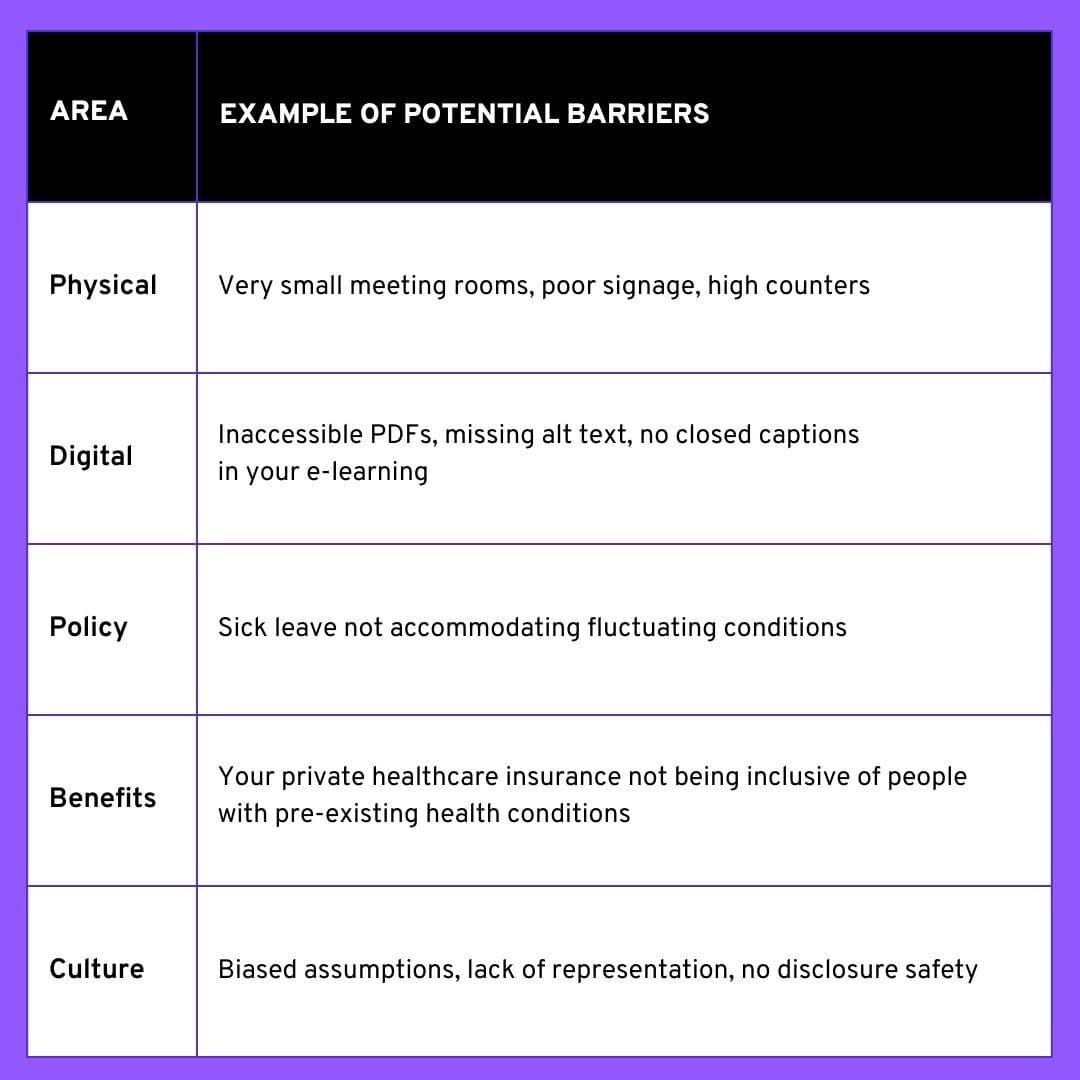
Involve disabled colleagues in these reviews, and act on their feedback.
4. Design inclusion into the full employee experience
Disability inclusion must reach beyond recruitment.
- In onboarding: offer information in multiple formats, allow more time, provide 1:1 walkthroughs. Don’t “medicalise” new joiner adjustments by going down the Occupational Health assessment route (e.g. somebody needing assistive technology like speech to text software should be directed to the IT team)
- In meetings: share agendas in advance, allow alternatives to speaking aloud, built in breaks.
- In performance reviews: accommodate how goals are tracked and discussed - allow flexibility in achieving these goals.
- In offboarding: gather feedback on inclusion and accessibility as standard. Take action on feedback you receive.
Informal inclusion matters too:
- Are team socials physically and sensory accessible? Can everybody access your Christmas/festive season party?
- Are disabled people considered for stretch opportunities and promotions?
- Are there disabled role models who have lived experience in leadership? Are they practising vulnerability and actively sharing their experiences?
5. Support inclusive line management
Managers make or break inclusion.
- Train all people managers in disability inclusion and bias awareness. They often need to boost their confidence levels.
- Provide toolkits with clear guidance on adjustments, “awkward” conversations, and support services.
- Encourage curiosity and empathy—ask, don’t assume.
- Normalise asking, “What can I do to make this easier for you?”
Don’t forget reverse - or reciprocal - mentoring. These can build understanding and accountability.
6. Create safety around “sharing”
Many disabled employees choose not to disclose a disability or long-term health condition - especially if they’ve had negative experiences in the past. You can’t force people to share, but you can focus on building trust.
- Use anonymous feedback tools to hear hidden voices.
- Share stories from disabled colleagues who’ve had positive experiences.
- Monitor inclusion survey responses by disability status (anonymised).
- Treat disclosure as an ongoing, evolving conversation—not a one-off tick box.
7. Track inclusion - not just headcount
Representation data is important. But alone, it won’t tell you if your culture is one of respect, belonging, empowerment or progression (the pillars of inclusion)..
Measure:
- Adjustments uptake and turnaround time
- Sense of belonging and psychological safety (comparing disabled and non-disabled employees to identify gaps)
- Progression, promotion, and pay equity for disabled employees
- Participation in development opportunities
Use this data to identify trends, gaps, and action areas.
Tip: Don’t wait for perfect data. Share what you do know, and be transparent about what you’re still working on.
You can learn more about the incredible work Toby has done by exploring his career story here. As a former Flexa Pioneer Award winner, he shares valuable insights into his journey, his passion for data-driven EDI strategies, and how he empowers teams to take ownership of equity
FAQs about accessibility-first workplaces
1. What does “accessibility-first” actually mean?
Accessibility-first workplaces design inclusion from the start—rather than treating it as an afterthought.
That means considering accessibility at every stage of work design: from tools and processes to physical spaces and culture. Instead of reacting to individual adjustment requests, accessibility-first employers remove barriers before they arise.2. Why is disability inclusion about culture, not just compliance?
Compliance ensures basic legal standards. Culture ensures people thrive.
When accessibility is only about meeting regulations, it can feel transactional and burdensome.
But when it becomes part of how an organisation thinks, designs, and collaborates—it unlocks innovation, engagement, and belonging for everyone.4. How can employers make adjustments for disabled employees?
Create a clear, low-friction process that normalises adjustments for everyone, not just disabled employees.
Publish simple, transparent guidance on how to request support.
Train managers to respond confidently and empathetically.
Remove unnecessary medical evidence requirements.
Treat adjustments as routine—like flexible hours, noise-cancelling headphones, or different workspace setups.
5. How can inclusion be embedded across the employee experience?
Disability inclusion should touch every stage of the employee journey:
Recruitment: accessible applications, clear language, flexible formats.
Onboarding: multiple learning formats, assistive tech available from day one.
Performance: adaptive goals and inclusive review processes.
Offboarding: feedback loops on accessibility and inclusion.
Informal culture matters too—think accessible socials, diverse role models, and equitable promotion opportunities.
6. What role do managers play in building accessibility-first cultures?
Managers are gatekeepers of inclusion. They set the tone for how supported employees feel.
Train them on disability confidence, adjustments, and inclusive communication. Encourage curiosity (“What can I do to make this easier for you?”) and use reciprocal mentoring to deepen understanding.7. How can organisations build safety around disability disclosure?
Trust drives disclosure. To build it:
Offer anonymous feedback tools.
Share real stories of inclusion from disabled colleagues.
Reinforce psychological safety through leadership communication.
Treat disclosure as an ongoing dialogue, not a one-off event.
The goal isn’t to increase disclosure rates—it’s to ensure people feel safe to share if and when they want to.
8. How should companies measure disability inclusion?
Representation data is only part of the picture. Measure:
Adjustment uptake and turnaround time
Sense of belonging and psychological safety
Pay, progression, and development parity
Accessibility of systems and spaces
Track trends over time, compare experiences between disabled and non-disabled employees, and be transparent about where you’re still improving.