

From balance to blend: why we need to rethink work-life integration
In today's remote world, work and personal life are mixing more than ever. This article explains why it's important to think about work and life together rather than getting fixated on 'work-life balance'.

By Molly Johnson-Jones
CEO and Co-Founder
12th May 2024
We need to stop obsessing over ‘work-life balance’. It’s a term that gets thrown around a lot, and while I’m all for having a life outside work, I also understand that this means different things to everyone. Our founder, like many others chooses to work longer hours some days and less on others. But that’s exactly what it is—a choice.
The reality is, we are all adults who should be trusted to work in a way that suits our individual lifestyles without having to be told we need this mythical ‘work-life balance’. That’s why I prefer the term 'work-life blend' as it focuses more on how we combine work with the rest of our lives.
In this blog, we will explore how to create flexible workplaces where people have the autonomy to work in the way they want. We'll discuss how to create an environment where work-life blend is not just encouraged but celebrated.
This blog will cover:
📈 How the flexible job market is growing
🗓️ How has the work week evolved?
🤸Why embedding flexibility into your EVP is essential
💻 5 ways to create a flexible workplace
The flexible job market is growing
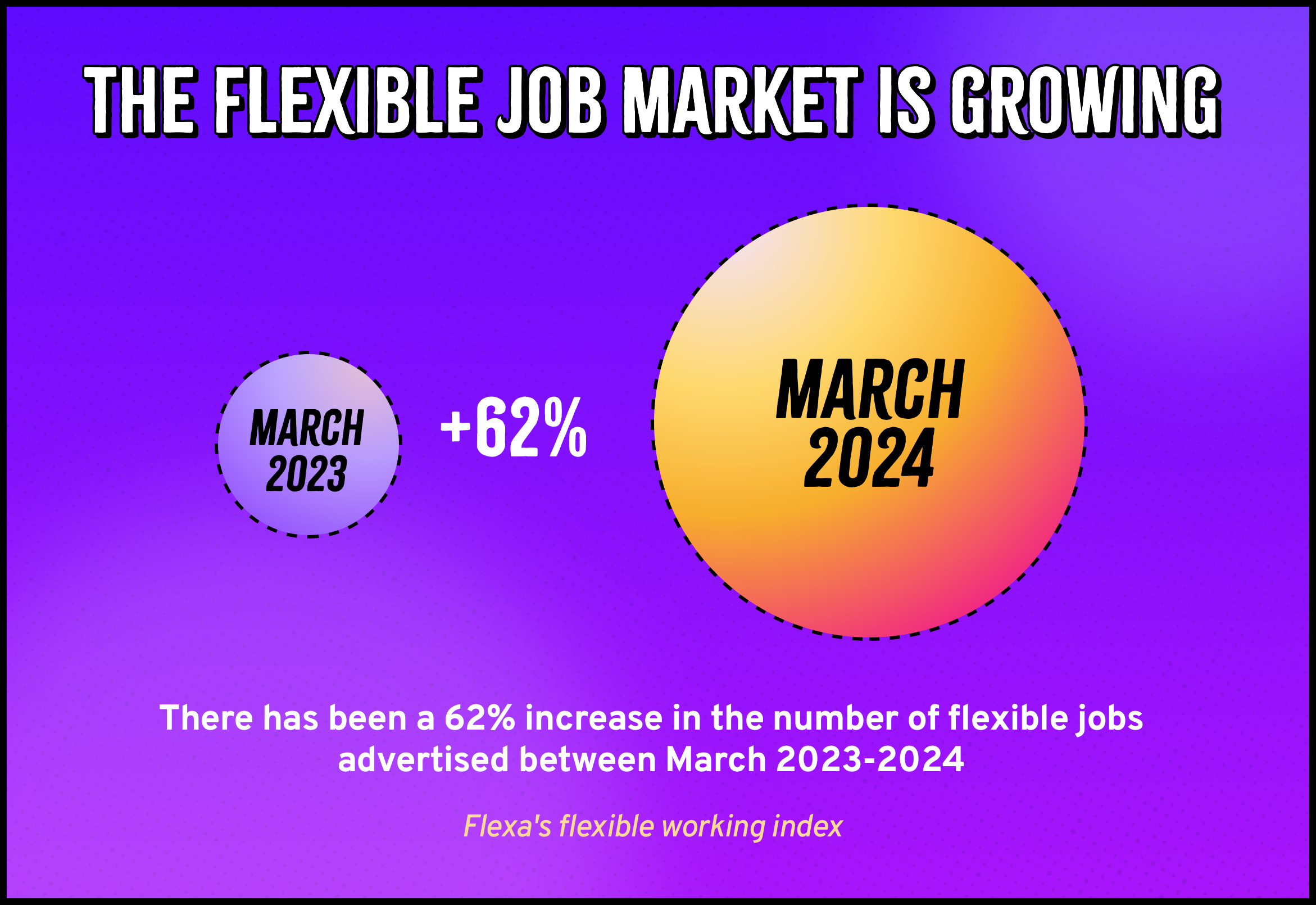
Despite a push from some companies for a return to the office (RTO), our latest Flexible Working Index indicates that the flexible job market is not only holding strong but is actually growing. The Index analysed data from over 4,000 job adverts, 840,000 job searches, and preferences expressed by over 8,500 job seekers between January and March 2024. One key finding is that there has been a 62% increase in the number of flexible jobs advertised compared to the same period last year, a significant growth considering broader labour market trends of shrinking wages, job vacancies, and rising unemployment rates.
So, what's driving this growth in flexible jobs, especially as some companies like Dell, Boots, and IBM are penalising or restricting remote work? One key factor is the persistent demand from job seekers for remote work options. Over the last quarter, half of workers on average were searching for "fully remote" roles, with demand increasing by 11% between January and March (from 47% to 52%). Similarly, just under half (42%) of workers were searching for "remote-first" jobs over the last quarter, with demand rising slightly by 5% between January and March (from 41% to 43%). This data suggests that despite RTO mandates, workers are holding out for the remote work options they've grown accustomed to, valuing them for better productivity, and wellbeing. Companies that fail to offer these options risk losing top talent to more flexible competitors.
How has the work week evolved?
The work week has evolved significantly over time, driven by changes in technology, societal norms, and employee expectations. Oh and a global pandemic!
From the traditional 9-to-5 office routine, we've seen a shift towards more flexible working arrangements. Here are some of the most popular flexible working arrangements:
- Fully remote: This type of flexible working lets you work from home within the country you were employed in all of the time.
- Remote-first: Similarly to remote, this means you can work from home most of the time. You may have the occasional office days which could be once a month or once a quarter.
- Hybrid: This type of work environment means there is a balance between in office and remote work and is the most popular amongst candidates as it offers the perfect blend of the two.
- WFA Schemes: Some companies will offer “Work From Anywhere” schemes. This means that you can travel abroad whilst working for a set amount of days or weeks every year without tax implications.
- Part-time: Part time work is described as working between 1 and 34 hours per week
- Compressed hours: Differently to core hours, which gives you more freedom over your day, compressed hours gives you more freedom over your week. As long as you work the hours required in the week, you can stack these up however suits you best.
- Evolved working week : Some of the most common iterations of an evolved working week include the 4-day week, 4.5-day week, and 9-day fortnight.
- The 4-day week is a flexible working arrangement where employees condense their standard 40-hour workweek into 4 days. How this works may vary depending on the organisation. Some companies may assign a specific day when all employees don’t work, while others may allow employees to choose which 4 days they work during the week. You can find out more about this by watching my latest webinar with Joe O'Connor, CEO at Work Time Reduction.
- The 4.5-day week is something we have in place at Flexa. This may work differently for each company; however, we have half-day Fridays, meaning our team can switch off for the weekend earlier and come back refreshed on Monday.
- The 9-day fortnight is a flexible working setup by which employees work only nine days out of a 10-day fortnight.
Why embedding flexibility into your EVP is essential
Let's talk about why embedding flexibility into your Employee Value Proposition (EVP) is absolutely crucial. Picture this: you're job hunting, scrolling through countless job listings. Suddenly, you stumble upon one that not only offers competitive pay and benefits but also highlights flexible work arrangements, meaning you can work in a way that fits your lifestyle.
You may be a parent who wants to spend more time with their children, a carer who needs to work around caregiving responsibilities, someone with a disability or health condition who can’t make it into the office or someone who simply wants the choice to work how and where they want.
Flexibility isn't just a perk anymore; for many it's become a necessity. When companies embrace flexibility as part of their EVP, they're sending a powerful message: "We trust you to manage your work and personal life in a way that works for you." And that is a game-changer. It attracts top diverse talent, boosts employee satisfaction, and ultimately leads to a more productive and engaged workforce. So, if you're not already weaving flexibility into your EVP, it's time to start.
5 ways to create a flexible workplace
- Offer flexible working options: Allow employees to adjust their work hours to better suit their needs, such as starting and ending their workday at different times or compressing their work week. By offering flexible scheduling, employees can better manage personal responsibilities, such as childcare or commuting challenges, leading to higher job satisfaction and productivity.
- Outcome over hours: Focus on outcomes rather than hours. Set your employees clear expectations and goals, which will give them the autonomy to manage their time and tasks to achieve these objectives. When employees are judged on their results rather than the time they spend at their desks, it creates a culture of trust and empowerment.
- Inclusive policies and practices: Implement policies that support the different needs of your employees, such as enhanced parental leave, work from anywhere schemes, and wellness programs. By recognising and accommodating diverse needs, you create a more inclusive EVP and supportive work environment where employees feel valued and respected.
- Train your managers: Remote working is different from in person. Make sure your managers are well-equipped to manage remote and hybrid teams. Providing training on effective communication, remote team building, and performance management in a remote setting ensures that managers can support their teams effectively, regardless of where they are located.
- Invest in your tech: Invest in technology that facilitates flexible work arrangements, such as collaboration tools, video conferencing software, and cloud-based systems. This means that employees can effectively communicate and collaborate regardless of their location.